
Why Audio Quality Is Still the Biggest Collaboration Challenge
- marktildesley
- Jan 29
- 3 min read
And why the conversation must extend beyond the meeting room
Most organisations still think about audio in terms of individual meeting rooms.
Fix the boardroom.
Upgrade the huddle spaces.
Standardise the kit.
But hybrid work has quietly changed the rules.....
Collaboration now happens everywhere — in open work areas, project spaces, town halls, training rooms, cafés, and across entire corporate estates. When audio quality breaks down in these spaces, the impact is amplified, not isolated.
The real challenge is no longer “How does this room sound?”It’s “How does collaboration feel across the workplace?”

From rooms to ecosystems: the corporate estate as a collaboration environment
A corporate estate is an interconnected system of experiences. People move between spaces throughout the day, carrying expectations shaped by what worked — or didn’t — in the last interaction.
Inconsistent audio performance across a Estate creates friction:
Meetings that feel effortless in one space and exhausting in another
Hybrid town halls where remote staff feel disconnected
Informal collaboration zones that discourage conversation due to noise or poor intelligibility
Audio quality becomes a signal. When it works consistently, it builds trust. When it doesn’t, people disengage or avoid certain spaces altogether.

Audio challenges at Estate scale
Designing audio at Estate level introduces complexity — but also opportunity.
Open and semi-open collaboration spaces
These areas support spontaneous interaction, but without careful design they become acoustically hostile. Competing conversations, reverberation, and noise spill quickly undermine speech clarity.
Here, the challenge is supporting collaboration without overwhelming the wider environment.
Large-format and shared spaces
Town halls, training rooms, atria, and divisible spaces place heavy demands on audio systems:
Variable occupancy
Multiple use cases
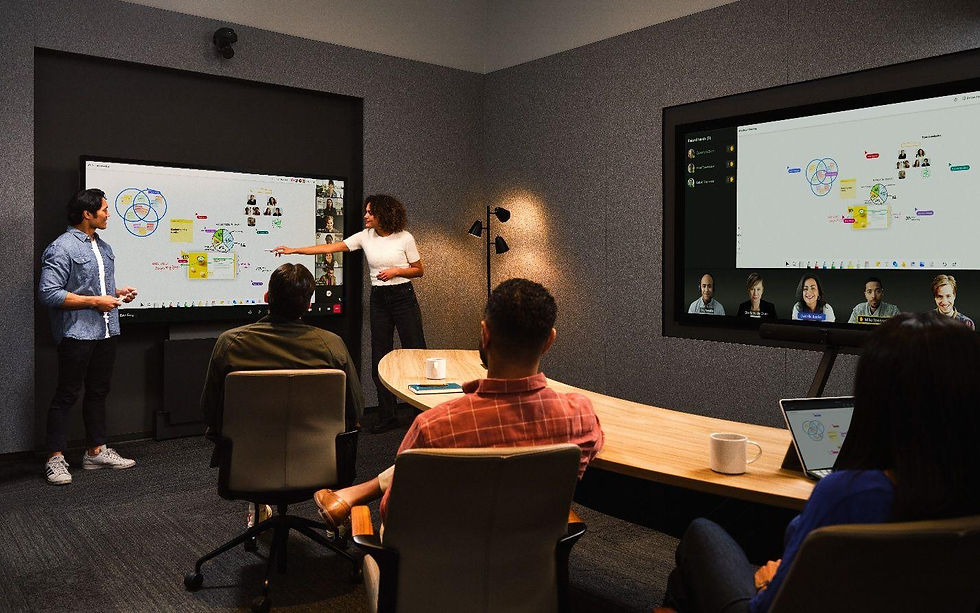
Hybrid participation at scale
Audio systems must adapt dynamical ly, not rely on manual reconfiguration.
Circulation spaces and social areas
Cafés, breakout zones, and informal seating are increasingly used for work conversations and hybrid calls — even if they weren’t originally designed for them.
Ignoring these spaces doesn’t stop collaboration from happening there. It just ensures a poor experience.
The remote Estate: digital parity matters
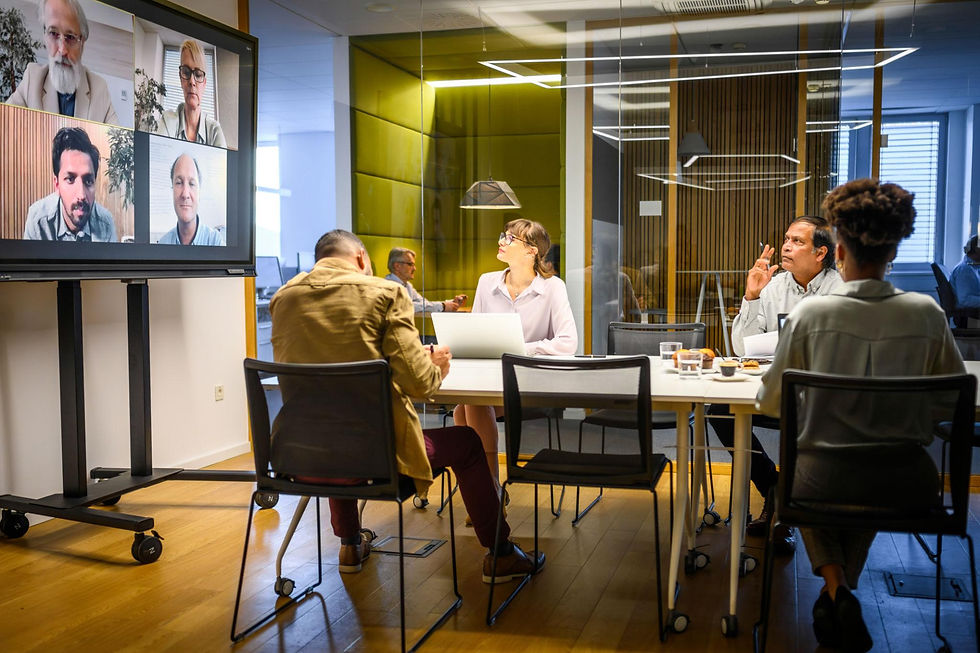
For remote participants, the entire Estate often collapses into a single audio experience. If voices from different spaces sound inconsistent, distant, or unclear, it reinforces a sense of separation.
Audio consistency becomes an inclusion issue.

What not to do at Estate scale
Poor habits become more damaging when repeated across dozens or hundreds of spaces
❌ Treating each space as a standalone project
Without a unifying strategy, organisations can quickly become fragmented — different standards, behaviours, and user experiences.
❌ Prioritising aesthetics without acoustic intent
Design-led environments that ignore acoustics often create the most challenging audio conditions. Visual consistency must be matched by acoustic performance.
❌ Over-standardising in the name of efficiency
Efficiency matters, but rigid templates applied across diverse spaces inevitably compromise experience.
❌ Ignoring sound as a shared resource
At Estate scale, sound travels. One space’s audio decisions affect another’s experience.

A consultative methodology for Estate-wide audio experience
Designing audio across a corporate Estate requires strategic intent, not just technical coordination.
1. Define the collaboration vision
Before touching technology, we work with stakeholders to define:
How collaboration should feel across the Estate
Which spaces support which behaviours
How in-person and remote experiences should align
This creates a shared north star for all design decisions.
2. Map the Estate soundscape
We analyse the Estate as an acoustic ecosystem:
Noise sources and movement patterns
Transitions between quiet and collaborative zones
How sound behaves across adjacent spaces
This informs zoning, material choices, and technology placement.
3. Design space typologies, not one-size templates
Instead of rigid room standards, we develop flexible space typologies:
Focused collaboration
Informal interaction
Large-scale engagement
Broadcast and presentation
Each typology has clear audio principles, while allowing for site-specific variation.
4. Integrate smart, adaptive audio systems
At Estate scale, intelligence matters:
AI-assisted noise management
Automatic microphone zoning
Usage analytics to inform optimisation
Audio becomes responsive, not reactive.
5. Govern, measure, and evolve
Estate-wide audio design doesn’t end at handover. Ongoing governance ensures:
Consistent experience over time
Informed upgrades rather than reactive fixes
Technology evolves alongside workplace behaviour
The outcome: a Estate that sounds as good as it looks
When audio is designed holistically:
Collaboration feels consistent wherever it happens
People choose spaces based on purpose, not fear of failure
Remote participants experience the Estate as cohesive and inclusive
Technology supports culture, rather than dictating it
This is what people-first design looks like at scale.

The future workplace is an audio experience
As organisations rethink the role of the office, the corporate Estate becomes a place for connection, creativity, and shared moments.
Audio shapes all of these — often invisibly, but always powerfully.
The question is no longer whether to design audio strategically, but how far the strategy extends.
👉 Learn more about designing effective collaboration spaces:


Comments